Blue mountains and hills.jpg

Specializing in the measurement of airborne particles

Founded in 1991, we are a small R&D company specializing in the measurement of airborne particles. These particles comprise the visual haze in the atmosphere, and are important to human health and global climate. Aerosol instruments developed by our firm are used for atmospheric research, routine monitoring, epidemiology studies and global climate research.
 

Our Instruments

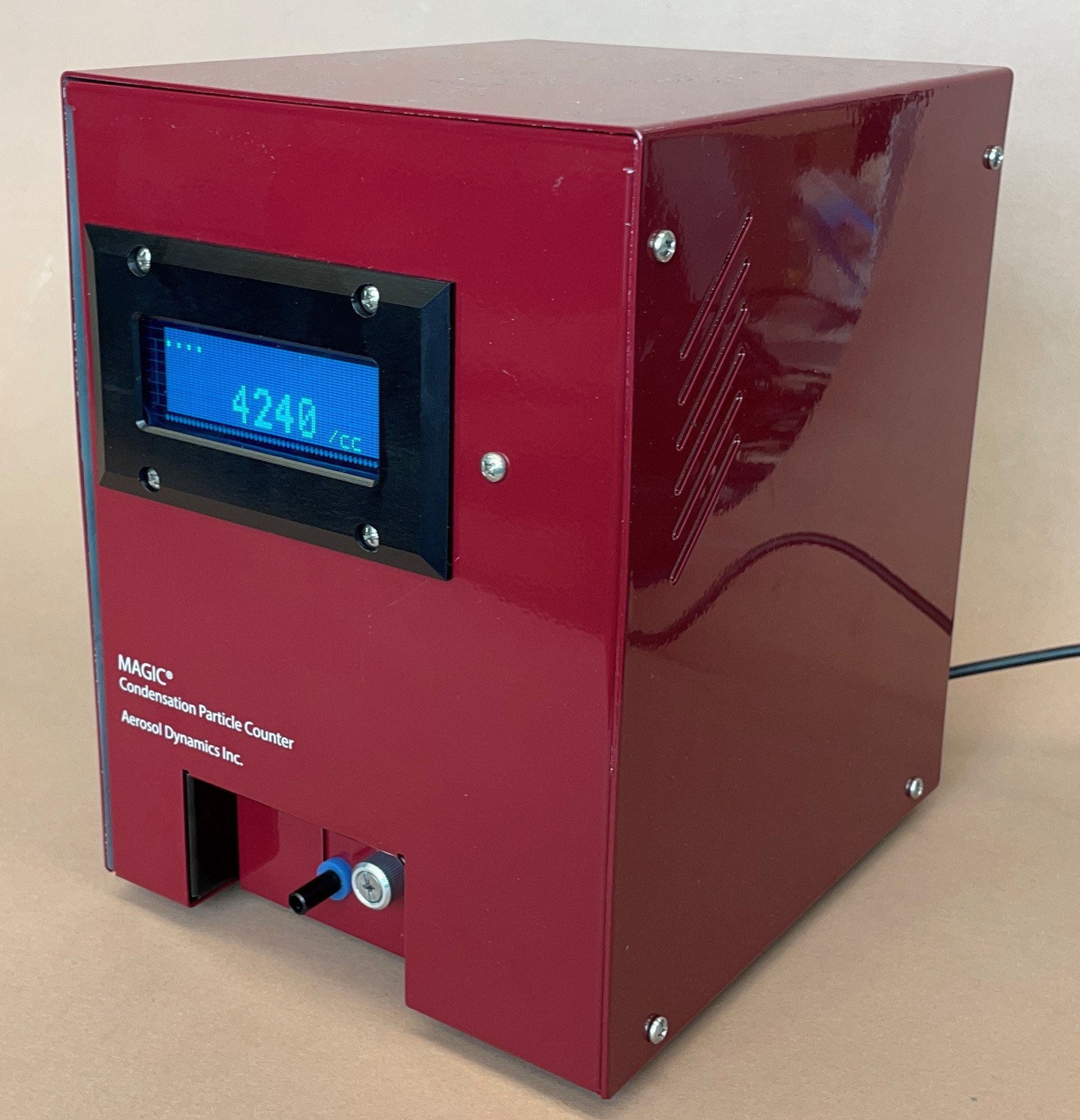
MAGIC® 250 Water-based Condensation Particle Counter

MAGIC is compact, motion-tolerant, battery operable water-based condensation particle counter. 


Spider-MAGIC® 810 Particle Mobility Spectrometer

Spider-MAGIC Combines the MAGIC wCPC technology with a compact radial DMA. Sizing range 9.5 – 500 nm.


Planar Cascade Impactor

BioCascade gently collects viable samples onto a variety of liquid media.


Community Airborne Particle Monitor

Counts ultrafine particles as small as 5 nm; performs optical sizing of particles 0.3 to 25 µm


Commercial Instruments Based ADI Inventions

BioSpot-VIVAS™

This collector is adapted for biological collection, and is exceptionally efficient for airborne virus capture, as demonstrated by our colleagues at the University of Florida.  VIVAS units are sold through Aerosol Devices. 


BioSpot-GEM™

The BioSpot-GEM bioaerosol sampler, provides fast and easy, yet high efficiency collection of bioaerosol particles directly onto a swab. Sold through Aerosol Devices.


Spot Sampler™

The Spot Sampler uses growth tube technology to collect particles as small as 5 nm onto a solid or liquid surface. Sold through Aerosol Devices.


TSI 3002

OmniCount™ Portable Water-based CPC. Sold through TSI.


TSI 3789 vWCPC

The “Versatile WCPC” uses our latest, water-based condensation technology to provide particle detection near 1 nm. Sold through TSI.


TSI 9001

AeroTrak Cleanroom CPC. Flow 2.8 L/min, false counts < 2.5 counts/m3


Research

AMI

The Aerosol Mobility Imaging technique is developed jointly with Jian Wang at Washington University in St. Louis. In a laminar flow, particles are positioned according to their electrical mobility and then grown by condensation, allowing for the size spectrum to be imaged optically.


C-TAG

“Comprehensive TAG”, developed with UC Berkeley, extends the thermal desorption aerosol gas chromatograph to include volatile organic compounds (VOCs) in addition to semi-volatile vapors and particles, spanning C5 to C30 compounds.