
Community Airborne Particle Monitor (CAPM)
Ultrafine, Fine, and Coarse Particle Counting
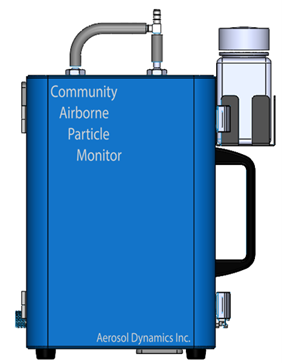
A dual sensor instrument that reports
Total particle number concentrations above 5 nm
Optically sized particles from 0.3 to 25 µm
The Community APM Model 160 includes:
Community Condensation Particle Counter (cCPC Datasheet PDF)
Optical particle counter (OPC Datasheet PDF)
Serial data logger
What it does:
The CAPM 160 has two particle sensors and a data logger.
The Community Condensation Particle Counter enlarges particles as small as 5 nm by water condensation to form optically detectable droplets. It reports total particle concentration above 5 nm (Particles Plus cCPC, model 15000-OEM).
The Optical Particle Counter sizes and counts particles from 0.3 to 25 µm, spanning much of the fine and coarse particle size ranges in 30 size channels. (Particles Plus OPC, model 9300P-OEM).
Data is combined and time-stamped on a data storage SD card using a serial data logger (Slerj SSR-SDU). Serial data from each sensor also on dedicated USB ports.
About the Community Condensation Particle Counter
By number, most ambient particles are in the ultrafine size range, and are too small to be directly detected by the OPC. The cCPC counts these ultrafine particles by first enlarging them by water condensation. The cCPC is an “expansion-type” condensation particle counter that first saturates the air sample and then expands it rapidly. The inherent cooling from the expansion creates the super-saturation (greater than 100% relative humidity) needed to condense water on ultrafine particles. The water-based cCPC is robust, highly precise and accurate, as illustrated in this figure of ambient air data that compares measurements among collocated cCPCs, and to research-grade condensation particle counters.
Example Data
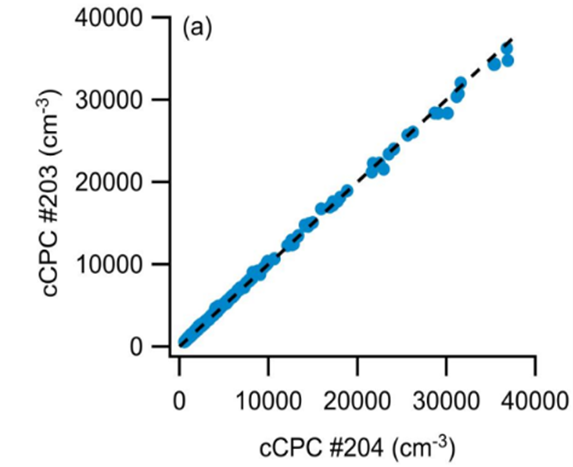
Data comparison between two cCPCs
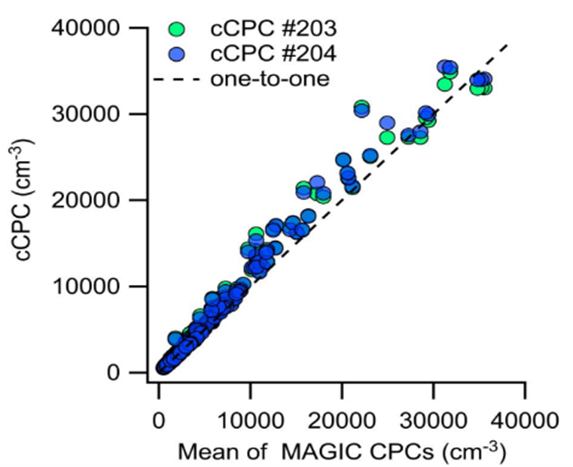
Data comparison between two cCPCs vs mean MAGIC CPC
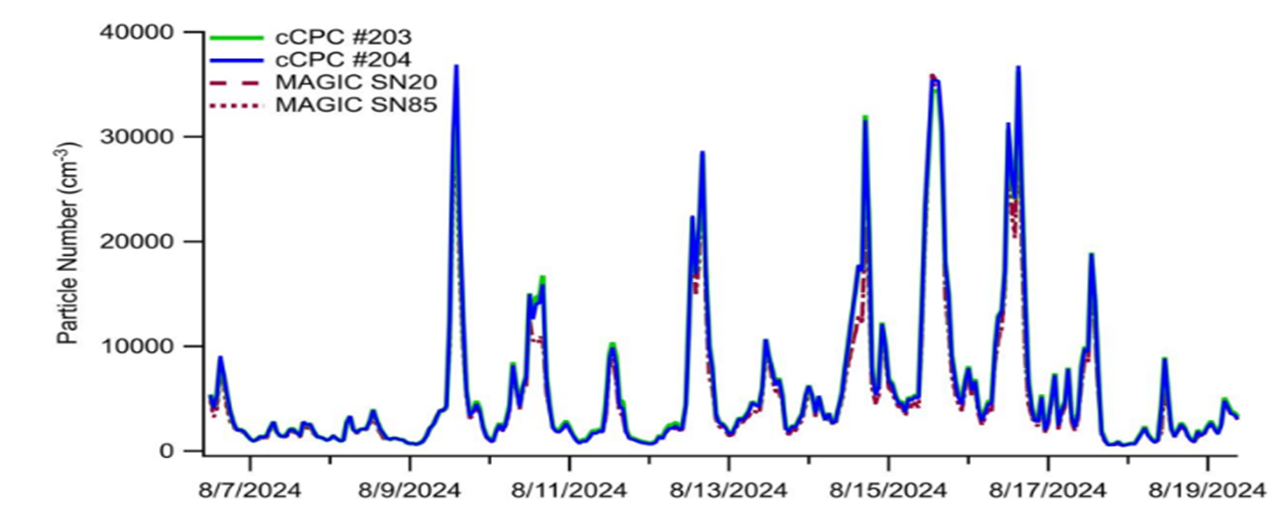
Time series of ambient data from two cCPCs and two Magic CPCs operated side-by-side in Berkeley, California. From Hering et al. (2025).